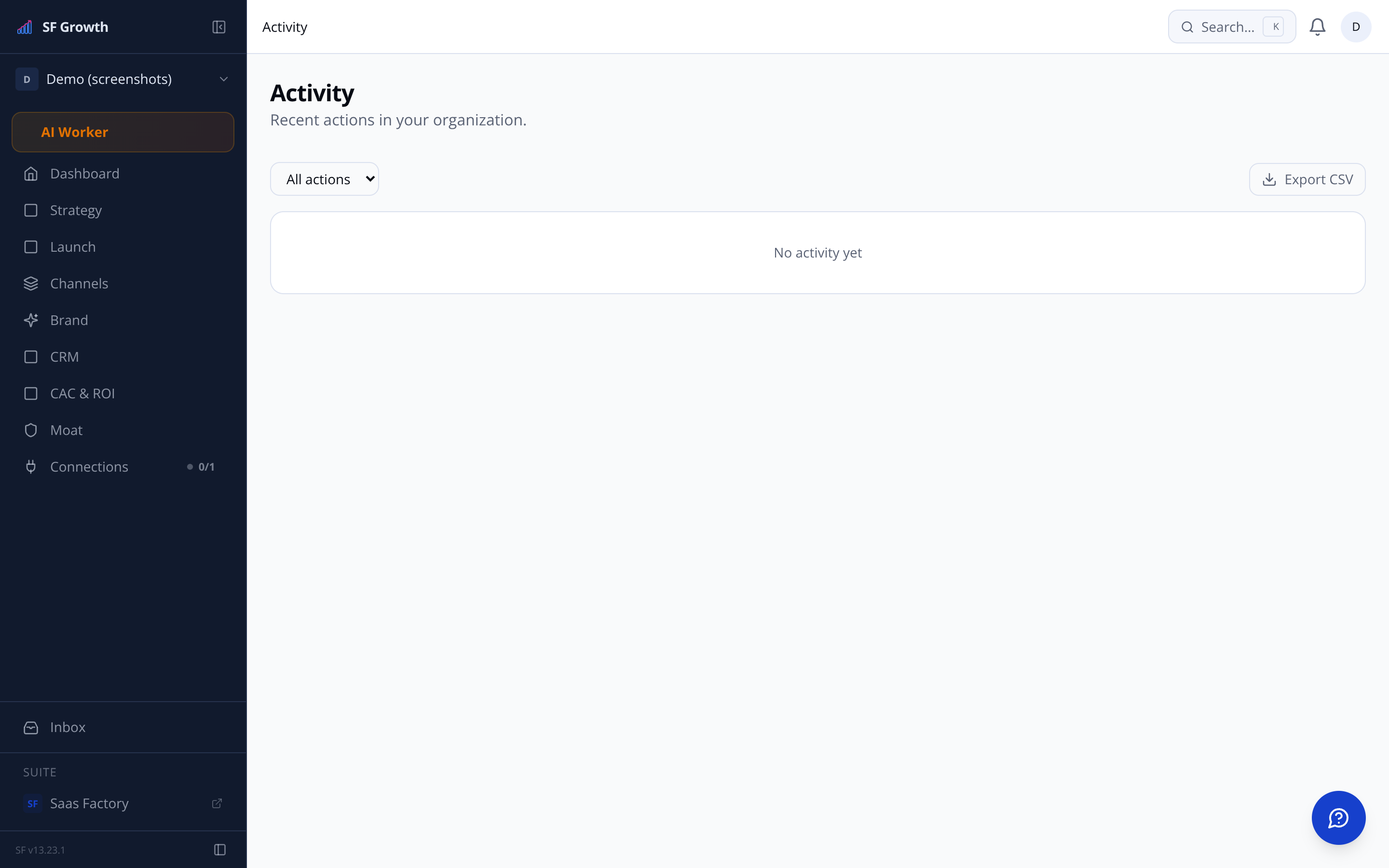
SF Growth connects your strategy to every channel, tracks how customers are won, and builds a moat score that compounds the longer you stay. Here is exactly what shipped.
[ CAPABILITY OVERVIEW ]
Six modules. One compounding system.
Strategy
Mission pulled live from SF Core. ICP auto-drafted. Brand voice, guardrails, and competitor monitoring all cascade to every sub-agent.
Channels
Website, SEO, AEO, and agent prospecting — all inheriting the same brand voice and guardrails from Strategy, written per-lead not from templates.
Launch
Auto-generated pre-launch checklist, countdown, and launch-day playbook. Agent auto-transitions to Scale view once your launch date passes.
CRM
Pre-seed leads, BAU leads, deals pipeline, and waitlist — tracked from first scraped signal through to login and first payment.
CAC & ROI
ROI, Customer Acquisition Cost, payback period, and referral fees paid. Basic attribution that tells you which channel is actually working.
Moat
A composite score across Domain Depth, Workflow Lock-in, and Data Flywheel. It compounds. It resets to zero if you leave. That's the point.
[ CHANNELS / AGENT SHELL ]
Channels: Draft → Approve → Publish, or hand it to the agent
Every channel runs on the same agent shell pattern — two modes only: Draft → Approve → Publish → Measure, or fully agentic. Brand voice, Don't-say, and Don't-talk-about cascade in automatically.
STEP 01 — WEBSITE
Built from Strategy, live on your domain
The website sub-agent reads Mission, ICP, Positioning, and Brand Assets. Three customer actions per page: prompt a change, edit directly, or create a new page. Default: SaaS Factory subdomain, live instantly. Recommended: your own domain via DNS connect.
STEP 02 — SEO + AEO
Search and answer engine optimisation in one pass
SEO sits as a tab within Channels. AEO — Answer Engine Optimisation — sits alongside it, generating structured answer content per page so your product appears in AI-powered search results as well as traditional ones.
STEP 03 — PROSPECTING
Per-lead outreach, written from the lead's profile
The prospecting agent reads where each lead was found, what they saw, and what they heard. It writes one message per lead using your brand voice, Don't-say, and Don't-talk-about — not a template with a name swapped in.
STEP 04 — COMPETITORS
Find them automatically. Monitor what matters.
Find Competitors runs a web search in your ICP space and surfaces a shortlist you approve. Add Competitor scans any URL and pulls Releases, Website, Ads, Content, and Company signals into a ranked card. Top competitor is monitored free; additional ones use tokens per toggle.
console
0.1s→ reading mission + ICP from Strategy
0.8s→ applying brand voice guardrails
1.4s✓ page generated — awaiting approval
2.1slive on subdomain · custom DNS ready
0.2s→ scanning page content for SEO signals
0.9s→ drafting AEO answer blocks per page
1.6s✓ optimisation layer applied
0.3s→ reading lead profile: source + context
1.1s→ composing outreach in brand voice
1.9s✓ message ready — email outreach queued
2.5spersonalised · guardrail-compliant · not templated
0.2s→ web search within ICP vertical
1.0s→ scanning competitor.com for signals
1.7s✓ competitor card created — monitoring on
2.3sdedupe checked · ranked #2 in your list
WEBSITE-AGENTPage regenerated after Strategy brand voice updatenow
ICP-AGENTConfidence score updated to 91% from 3 new conversions2m ago
COMPETITOR-SCANReleases feed updated for tracked competitor #24m ago
PROSPECTING-AGENTOutreach drafted for 6 new Pre-Seed leads7m ago
AEO-AGENTAnswer blocks refreshed across 4 pages11m ago
MOAT-AGENTData Flywheel pillar updated — 3 improvements shipped this month14m ago
LAUNCH-AGENTChecklist item marked complete — 3 remaining pre-launch19m ago
WEBSITE-AGENTPage regenerated after Strategy brand voice updatenow
ICP-AGENTConfidence score updated to 91% from 3 new conversions2m ago
COMPETITOR-SCANReleases feed updated for tracked competitor #24m ago
PROSPECTING-AGENTOutreach drafted for 6 new Pre-Seed leads7m ago
AEO-AGENTAnswer blocks refreshed across 4 pages11m ago
MOAT-AGENTData Flywheel pillar updated — 3 improvements shipped this month14m ago
LAUNCH-AGENTChecklist item marked complete — 3 remaining pre-launch19m ago
WEBSITE-AGENTPage regenerated after Strategy brand voice updatenow
ICP-AGENTConfidence score updated to 91% from 3 new conversions2m ago
COMPETITOR-SCANReleases feed updated for tracked competitor #24m ago
PROSPECTING-AGENTOutreach drafted for 6 new Pre-Seed leads7m ago
AEO-AGENTAnswer blocks refreshed across 4 pages11m ago
MOAT-AGENTData Flywheel pillar updated — 3 improvements shipped this month14m ago
LAUNCH-AGENTChecklist item marked complete — 3 remaining pre-launch19m ago
WEBSITE-AGENTPage regenerated after Strategy brand voice updatenow
ICP-AGENTConfidence score updated to 91% from 3 new conversions2m ago
COMPETITOR-SCANReleases feed updated for tracked competitor #24m ago
PROSPECTING-AGENTOutreach drafted for 6 new Pre-Seed leads7m ago
AEO-AGENTAnswer blocks refreshed across 4 pages11m ago
MOAT-AGENTData Flywheel pillar updated — 3 improvements shipped this month14m ago
LAUNCH-AGENTChecklist item marked complete — 3 remaining pre-launch19m ago
[ LAUNCH / PRE-LAUNCH PHASE ]
Launch: auto-generated checklist, countdown, and day-one playbook
Pre-launch phase
The Growth Agent auto-generates a 15–20 item checklist from your product context. Set a countdown yourself or anchor it to a regulatory deadline. The launch-day playbook sequences your waitlist email, social posts, ads, outbound, and influencer posts by time.
15–20 item checklist generated from product context
Countdown with date + time picker — deadline-anchored if needed
Days-to-launch widget updates in real time
Launch-day playbook: timed sequence of every channel action
Agent auto-switches to Scale view once launch date passes
[ CRM / PRE-SALES THROUGH TO FIRST PAYMENT ]
CRM: one record from first signal to closed won
SF Growth owns pre-sales. When a lead creates a login, the contact auto-promotes to SF Success as an unpaying customer. The Growth record updates to 'Created Login' with deal value tracked — no double-entry, auto-linked by email.
Pre-Seed Leads
Scraped and matched — not yet engaged
Pre-seed leads are sourced via the built-in Apify scraper (white-labelled — you never connect your own account) or matched against your ICP. Each record shows where the lead was found, what they saw, and any profile signals — multi-source matches merge into a richer profile rather than creating duplicates.
BAU Leads
Actively engaged or self-registered
BAU leads are in motion — engaged via outreach or self-registered via waitlist. The contact record carries source, profile, and every interaction from this point forward into the Deals Pipeline.
Deals Pipeline
Trial → Engaged → Proposal Sent → Closed Won
Four pipeline stages with metrics: Bookings Value (weighted pipeline), MRR/ARR booked, Win rate, and Sales cycle length. Billing lives in SF Revenue — Growth tracks the deal, not the invoice.
Sources
Active scrapers, lead counts, monthly spend
The Sources tab shows which Apify scrapers are running, how many leads each has produced, and your monthly spend total. The markup is held by SaaS Factory — your screen shows only your cost, not the underlying rate.
[ MOAT / COMPOUNDING INTELLIGENCE ]
Your moat score compounds. It resets to zero the day you leave.
The Compounding Moat Score is a single composite number from three pillars — Domain Depth, Workflow Lock-in, and Data Flywheel. It shows your monthly percentage change and a trailing 3-month average. Status bands: Compounding / Growing / Flat / Eroding.
Domain Depth (35%)Vertical knowledge captured — regulatory rules, industry jargon, VECs — with a 180-day decay model keeping the score honest.
Workflow Lock-in (40%)Switching Friction score 0–100. Driven by live integrations, AI worker use, and embedded workflows.
Data Flywheel (25%)Improvements shipped this month from behavioural signals, patterns detected, and improvements identified.
[ CAC & ROI / ATTRIBUTION ]
CAC & ROI: the numbers that tell you which channel is actually working
The CAC & ROI module gives you basic attribution without requiring a data science team. Four headline metrics surface immediately after you connect your first channel.
ROIReturn on every pound spent across tracked channels
Customer Acquisition CostWhat it costs to win a paying customer, by source
Payback periodMonths to recover your CAC at current MRR
Referral fees paidTrack what you're paying partners and affiliates
CAC TREND
CAC tracked
Representative workload shape — your numbers populate on connect
JanJunDec
[ HOME DASHBOARD / COMMAND CENTRE ]
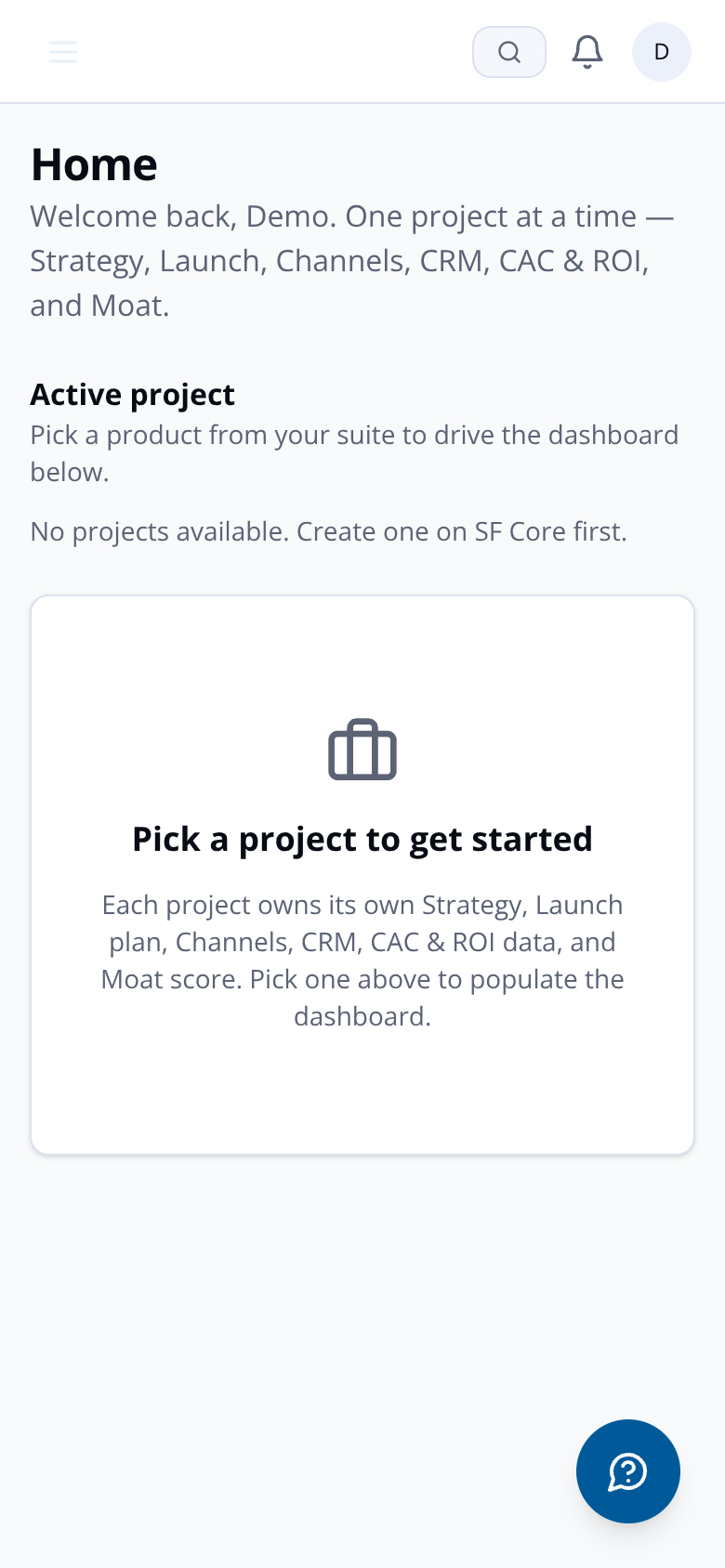
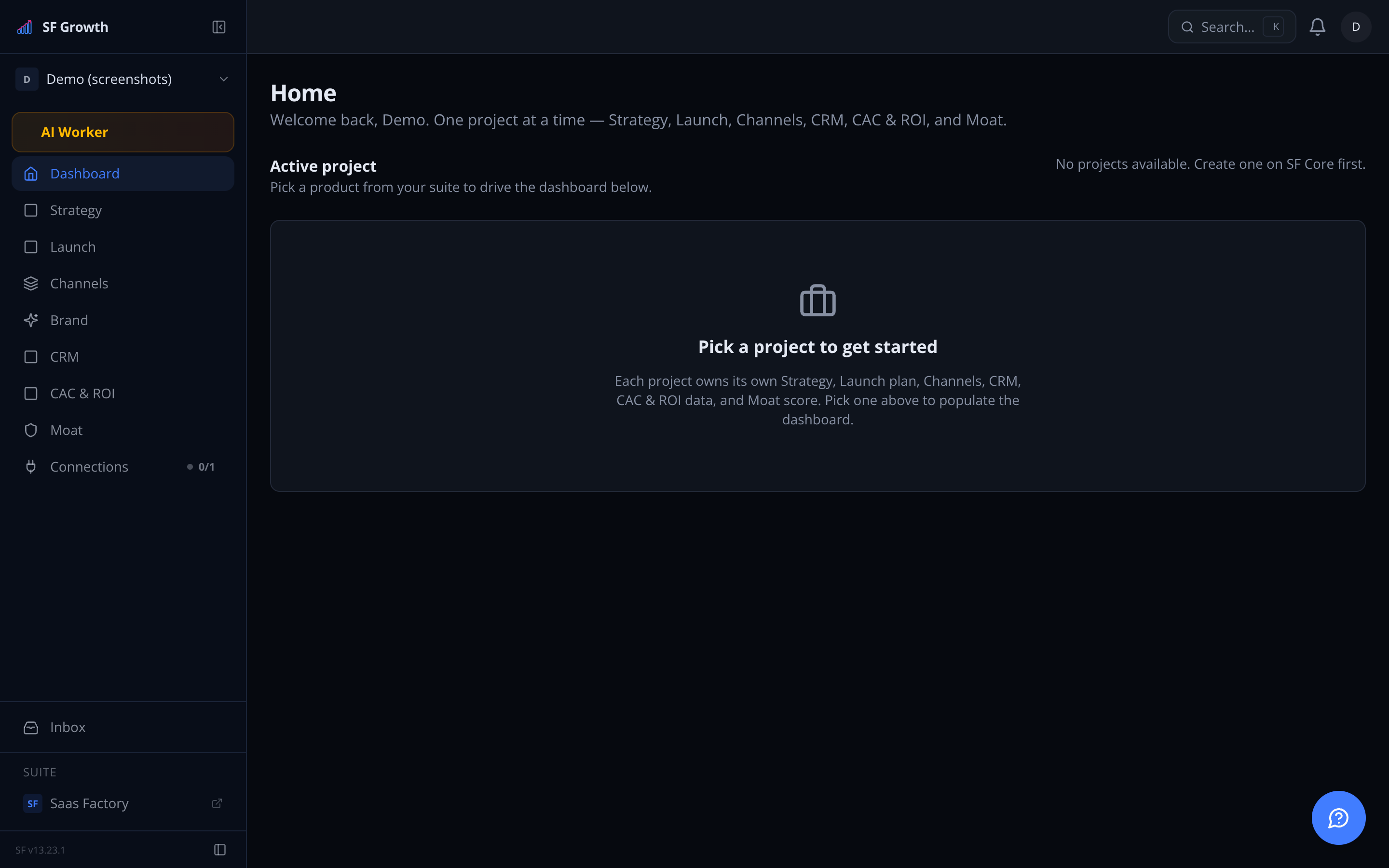
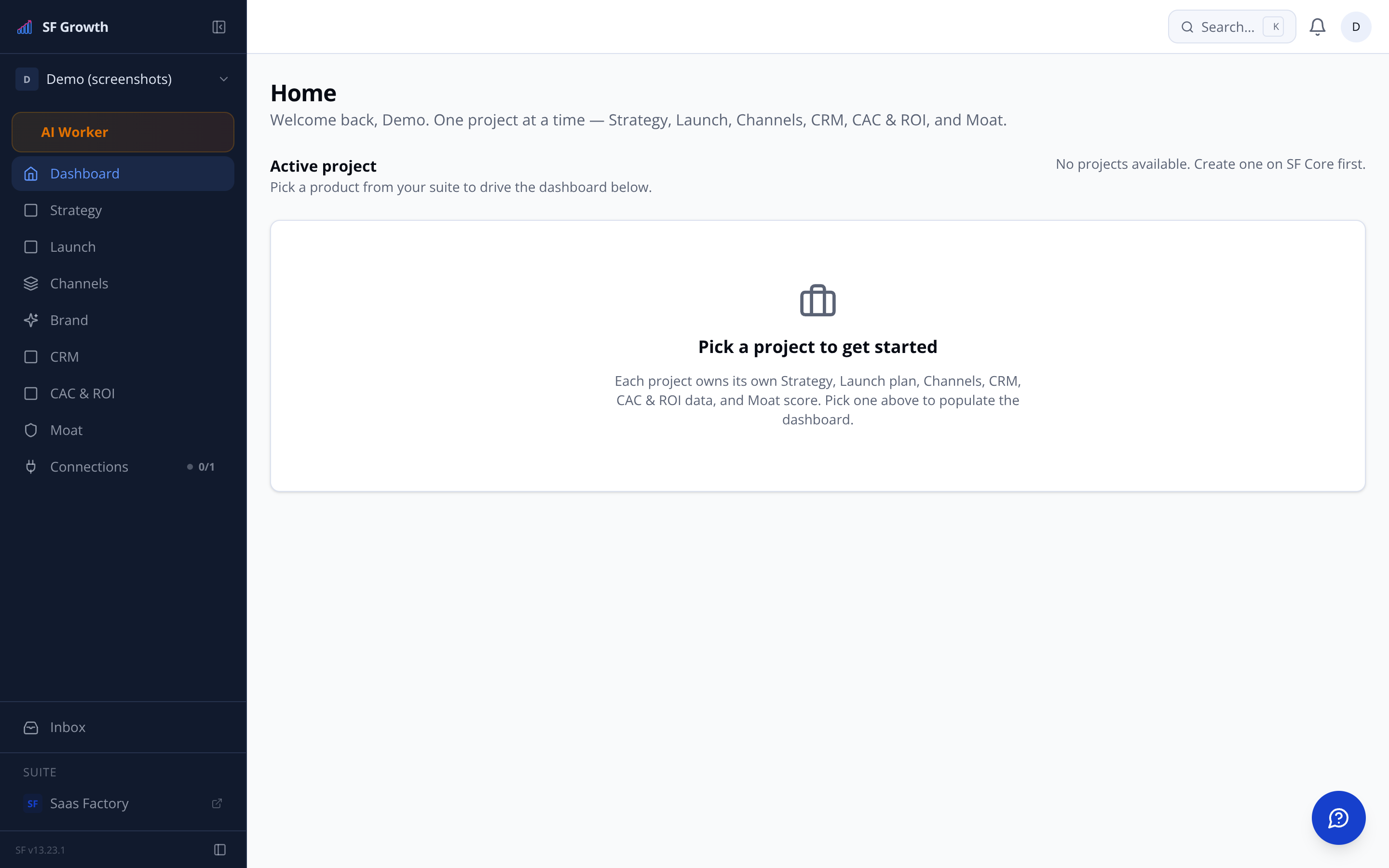
The dashboard: every module in one screen, live agent activity ticking in real time
After login, the project picker scopes everything to your product. Six section cards show headline numbers, latest activity, and one-line status. A live activity ticker pulses in real time — so you always know which agent is working, without opening the section.
60
Features shipped
6
Core modules
2
Agent modes per channel
3
Moat pillars compounding
[ FAQ ]
Feature questions, answered directly
SF Growth is an AI-assisted growth operating system built for early-stage SaaS products. It houses a set of specialist sub-agents that handle strategy, channel execution, competitor monitoring, CRM, launch sequencing, and compounding moat scoring — all under one roof, scoped to your specific product. Your team sets direction; the agents do the production work. Think of it as a growth function that scales with you, not a replacement for one.
SF Growth connects to SaaS Factory Core, where your product's mission, market, vertical, and positioning already live. On first load, the Growth Agent pulls that context automatically — populating your Mission Statement, Ideal Customer Profile, and Market Strategy without manual entry. The Confidence Score on your ICP rises over time as the agent learns from real conversion data, so the system gets sharper the longer you use it.
At this tier, the supported channels are Website and Prospecting (email outreach). Your website is generated directly from your Strategy — mission, ICP, brand voice, don't-say lists, and brand assets all flow in as guardrails. Prospecting writes per-lead outreach in your brand voice; it does not use templates. Every channel runs in one of two modes: Draft → Approve → Publish → Measure, where you review before anything goes live, or fully agentic, where the agent publishes and iterates on its own. You choose the mode per channel.
The Compounding Moat Score (CMS) is a single composite number that measures how hard your product is becoming to leave. It draws from three pillars: Domain Depth (vertical knowledge your agents have captured), Workflow Lock-in (how embedded SF is in your operating rhythm), and Data Flywheel (improvements shipped from behavioural signals). The headline shows your monthly percentage change; a trailing three-month average tells you whether you're accelerating or eroding. The score is read-only and resets to zero if you leave SF — that is intentional. It compounds because you stay.
Both. The Launch section runs a pre-launch checklist, a countdown, and a timed launch-day playbook covering waitlist emails, social posts, ads, and outbound. Once your launch date passes, the sub-agent automatically transitions to the Scale view, which surfaces live MRR, paying customers, weekly signups, a Velocity Score, conversion rates from signup to trial to paid, and forward milestones suggested by the Growth Agent and refreshed weekly. You can manually toggle between Launch and Scale views at any point to preview either.
For pre-sales and early pipeline, no. The CRM covers five areas: Overview, Pre-Seed Leads, BAU Leads, Deals Pipeline (Trial through to Closed Won), and Sources. When a lead self-signs up and creates a login in SaaS Factory, their Growth record updates automatically — the contact record follows them from first touch through to paid usage. Billing, pricing, dunning, and MRR booking are handled in SF Revenue, not here, so there is no overlap. If your question is about a capability not listed, details are available on request.
[ GET ACCESS ]
60 features. One compounding system.
Join the waitlist and be first in when we open access. Questions? Email us at sf-core-org-support-sf-growth@saas-factory.ai
[ STRATEGY / FEATURE DEEP-DIVE ]
Strategy: the source of truth every agent reads
Mission pulled live from SF Core
The Mission tab reads your mission statement directly from SF Core — no copy-paste, no drift. Market, Vertical, and Last Synced timestamp sit beneath it as read-only context cards, refreshed on every sync.
Mission statement synced live — never stale
Market + Vertical tags auto-populated from Core
Market Strategy drafted by your Growth Agent: How we win, Distribution thesis, Pricing position, Launch anchor, Primary moat
Changes cascade to Website, AEO, Content & Social sub-agents
ICP drafted by the Growth Agent — refined as you learn
The ICP tab loads from SF Core on first open. Primary ICP and Vertical appear as structured bullet cards — not a blank text box. A Confidence score (0–100) rises automatically as the Growth Agent learns from real conversions. Each bullet is a targeting guardrail that every channel sub-agent consumes.
Auto-populated from SF Core — editable, not locked
Confidence score rises with real conversion data
Structured bullets feed channel agents as guardrails
Refresh from Core at any time
Positioning, Validation & Brand Assets
Positioning
Brand voice that every channel agent inherits
Set your tonality, register, and style once. Add phrases to the Don't-say list and topics to the Don't-talk-about list. Every channel sub-agent — website, email, social — writes within those rails automatically.
Validation
Pain score, Workaround score, Mission Fit — before and after launch
Pre-launch: an evidence log of structured interviews anchored on 'Tell me about the last time you dealt with this problem.' Post-launch: Sean Ellis Test — 40%+ Very Disappointed is the PMF threshold. The Growth Agent scores each dimension 0–100.
Brand Assets
Upload a logo. Get a full asset pack.
Upload your primary logo and brand colours. The sub-agent auto-generates: favicon, iOS and Android app icons, all social profile sizes, email header, OG and Twitter card images, splash screens, and 404/empty-state graphics. Font selector draws from the common web-enabled set.